LCL and FCL Shipments: Complete Guide to Choosing the Right Container Load in 2025

Introduction
When it comes to international shipping and ocean freight, understanding the difference between LCL and FCL shipments is crucial for optimizing your supply chain and reducing logistics costs. Whether you’re a small business owner shipping your first container or an experienced importer looking to streamline operations, choosing between Less than Container Load (LCL) and Full Container Load (FCL) can significantly impact your bottom line.
In this comprehensive guide, we’ll break down everything you need to know about LCL and FCL shipments, helping you make informed decisions that align with your business needs and cargo requirements.
What Are LCL and FCL Shipments?
LCL Shipments (Less than Container Load)
LCL shipping, or Less than Container Load, refers to ocean freight shipments where your cargo doesn’t fill an entire container. In LCL shipments, multiple shippers share container space, with each paying only for the volume or weight they use. This consolidation service is handled by freight forwarders who combine cargo from different exporters heading to similar destinations.
Key characteristics of LCL shipping:
- Shared container space with other shippers
- Charged by cubic meter (CBM) or weight
- Ideal for smaller cargo volumes
- Requires consolidation and deconsolidation processes
- Lower minimum quantity requirements
FCL Shipments (Full Container Load)
FCL shipping, or Full Container Load, means you’re renting an entire shipping container exclusively for your cargo. Whether you fill it completely or not, the container is sealed at origin and remains sealed until it reaches the final destination, providing enhanced security for your goods.
Key characteristics of FCL shipping:
- Exclusive use of entire container
- Standard container sizes: 20ft and 40ft containers
- Flat rate regardless of space utilization
- Direct container movement from origin to destination
- Better security and reduced handling
LCL vs FCL: Key Differences Comparison
Cost Structure
LCL Shipping Costs: LCL freight rates are calculated based on volume (cubic meters) or weight, whichever is greater. While the per-unit cost appears higher, you only pay for the space you use. Additional charges include:
- Consolidation fees at origin
- Deconsolidation charges at destination
- Container freight station (CFS) handling fees
- Documentation and processing charges
FCL Shipping Costs: FCL rates are quoted as a flat fee per container, regardless of how much space you utilize. This makes FCL more cost-effective when you have sufficient cargo volume. The pricing structure is simpler with fewer handling fees.
Break-even Point: The typical break-even point between LCL and FCL occurs around 15-18 cubic meters (CBM) for standard routes. However, this varies by trade lane, season, and current market rates.
Transit Time
LCL Transit Times: LCL shipments typically take longer due to:
- Consolidation time at origin port (3-7 days)
- Deconsolidation time at destination (2-5 days)
- Potential delays waiting for sufficient cargo to fill containers
- Multiple handling points increasing overall transit time
FCL Transit Times: FCL containers offer faster transit times because:
- Direct loading and unloading
- No consolidation delays
- Priority handling at ports
- Immediate availability once cargo is ready
On average, FCL shipments are 7-14 days faster than LCL on the same route.
Security and Risk
LCL Security Considerations: With LCL shipping, your cargo shares space with goods from other shippers, which presents certain risks:
- Multiple touchpoints increase damage risk
- Potential contamination from other cargo
- Higher likelihood of customs inspections
- Less control over handling procedures
FCL Security Advantages: FCL offers superior security because:
- Container sealed at origin factory
- Single shipper’s goods only
- Reduced handling minimizes damage risk
- Lower inspection probability
- Better for high-value or fragile items
Flexibility and Cargo Volume
When LCL Makes Sense:
- Small to medium cargo volumes (typically under 15 CBM)
- Testing new markets with smaller orders
- Irregular shipping schedules
- Budget constraints for smaller businesses
- Low-value commodity goods
When FCL Is Preferable:
- Large shipment volumes (over 15 CBM)
- Regular, consistent shipping needs
- Time-sensitive deliveries
- High-value or fragile merchandise
- Oversized or heavy cargo requiring special handling
Standard Container Sizes and Capacity
Understanding container dimensions helps you calculate whether FCL makes financial sense:
20ft Container (TEU)
- Interior dimensions: 19’4″ x 7’9″ x 7’10”
- Capacity: 33 cubic meters (1,172 cubic feet)
- Maximum payload: 28,000 kg (61,729 lbs)
- Ideal for: Dense, heavy cargo
40ft Container (FEU)
- Interior dimensions: 39’6″ x 7’9″ x 7’10”
- Capacity: 67 cubic meters (2,385 cubic feet)
- Maximum payload: 27,000 kg (59,525 lbs)
- Ideal for: Voluminous, lighter cargo
40ft High Cube Container
- Interior dimensions: 39’6″ x 7’9″ x 8’10”
- Capacity: 76 cubic meters (2,694 cubic feet)
- Maximum payload: 27,000 kg (59,525 lbs)
- Ideal for: Bulky, lightweight goods
How to Calculate Your Break-Even Point
Determining when to switch from LCL to FCL requires careful cost analysis:
Step-by-Step Calculation:
- Get LCL quote per CBM – Request rates from freight forwarders
- Calculate total LCL cost – Multiply your cargo volume by per-CBM rate, plus fees
- Get FCL quote – Obtain flat rate for 20ft or 40ft container
- Compare totals – Factor in all additional charges
- Consider transit time value – Calculate cost of delayed inventory
Example Calculation:
- LCL rate: $80 per CBM
- Your cargo: 16 CBM
- LCL total: 16 x $80 = $1,280 + $400 (fees) = $1,680
- FCL 20ft quote: $1,500
- Result: FCL saves $180 and arrives faster
Documentation Requirements
LCL Shipping Documents:
- Commercial invoice
- Packing list (detailed)
- Bill of Lading (House B/L)
- Certificate of origin
- Cargo insurance (recommended)
- Consolidation manifest
FCL Shipping Documents:
- Commercial invoice
- Packing list
- Bill of Lading (Master B/L or House B/L)
- Certificate of origin
- VGM (Verified Gross Mass) certificate
- Container loading plan
- Cargo insurance
Environmental Considerations
LCL Environmental Impact: LCL consolidation maximizes container utilization, reducing empty space and potentially lowering the carbon footprint per shipment. However, additional handling and longer transit times may offset some benefits.
FCL Environmental Impact: While FCL provides exclusive container use, underutilized space increases environmental impact per cargo unit. Full container utilization is essential for sustainability.
Tips for Choosing Between LCL and FCL Shipments
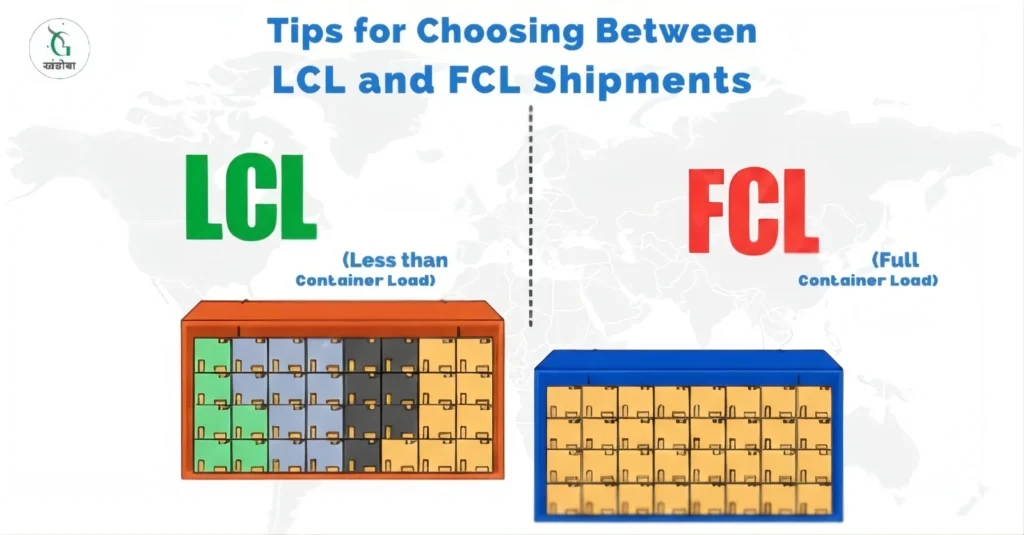
Choose LCL When:
- Your shipment is less than 15 cubic meters
- You’re starting a new product line with test orders
- Budget is more important than speed
- Shipping non-urgent, low-value goods
- You have irregular shipping patterns
- Storage space at destination is limited
Choose FCL When:
- Your cargo volume exceeds 15-18 cubic meters
- Time-sensitive delivery is required
- Shipping high-value or fragile products
- You need maximum security and minimal handling
- Regular, scheduled shipments justify container costs
- Cargo requires temperature control or special handling
Common Mistakes to Avoid
LCL Shipping Mistakes:
- Poor packaging leading to damage during consolidation
- Inaccurate measurements causing unexpected charges
- Not comparing multiple freight forwarders
- Underestimating total transit time
- Inadequate cargo insurance coverage
FCL Shipping Mistakes:
- Booking FCL for insufficient cargo volume
- Improper container loading and weight distribution
- Missing container return deadlines (demurrage charges)
- Choosing wrong container type for your cargo
- Not securing proper equipment for unloading
Impact of Trade Routes and Seasons
Shipping costs and availability vary significantly by:
Major Trade Routes:
- Asia to North America
- Europe to Asia
- Intra-Asia routes
- Transatlantic shipping
Peak Seasons:
- Pre-Chinese New Year (January-February)
- Back-to-school season (July-August)
- Pre-Christmas rush (September-November)
During peak seasons, FCL container availability decreases and rates increase substantially. Planning ahead and booking early becomes critical.
Working with Freight Forwarders
Questions to Ask Your Freight Forwarder:
- What is the total door-to-door cost including all fees?
- What is the estimated transit time for LCL vs FCL?
- Are there consolidation delays on this route?
- What insurance options do you recommend?
- What are the demurrage and detention policies?
- Do you offer customs clearance services?
- What documentation support do you provide?
Red Flags to Watch For:
- Quotes that seem too good to be true
- Hidden fees not disclosed upfront
- Poor communication and responsiveness
- Lack of tracking capabilities
- No clear terms and conditions
Future Trends in Container Shipping
Digital Transformation:
- Real-time container tracking technology
- Blockchain for transparent documentation
- AI-powered route optimization
- Digital freight platforms connecting shippers directly
Sustainability Initiatives:
- Alternative fuel vessels reducing emissions
- Smart containers with IoT sensors
- Improved vessel efficiency standards
- Carbon offset programs for shippers
Market Dynamics:
- Fluctuating container rates post-pandemic
- Port congestion management solutions
- Increased near-shoring affecting shipping patterns
- Growing e-commerce driving smaller, frequent shipments
Conclusion
Choosing between LCL and FCL shipments requires careful consideration of your cargo volume, budget, timeline, and security requirements. While LCL offers flexibility and lower entry costs for smaller shipments, FCL provides better economics, faster transit, and enhanced security for larger volumes. The key is to calculate your specific break-even point, considering all costs and business factors. As your business grows and shipping volumes increase, regularly reassess whether it’s time to transition from LCL to FCL to optimize your international shipping strategy.
Remember that the optimal choice may change based on seasons, routes, and market conditions. Working with experienced freight forwarders and staying informed about container shipping trends will help you make the best decisions for your supply chain in 2025 and beyond.
Ready to ship? Consult with the experts at Samruddhii Global (Navkar Logistics Pvt Ltd. CHA No. 11/473), compare quotes for both LCL and FCL options, and choose the solution that best balances cost, speed, and security for your specific cargo needs.
Frequently Asked Questions (FAQs)
Q: What does LCL stand for in shipping?
A: LCL stands for Less than Container Load, where multiple shippers share container space and pay only for the volume they use.
Q: What is the main difference between LCL and FCL?
A: The main difference is that LCL involves shared container space with other shippers, while FCL means renting an entire container exclusively for your cargo.
Q: At what volume should I switch from LCL to FCL?
A: The typical break-even point is around 15-18 cubic meters, but this varies by route and current market rates. Always compare quotes for both options.
Q: Is FCL faster than LCL?
A: Yes, FCL shipments are typically 7-14 days faster because they don’t require consolidation and deconsolidation processes.
Q: Which is more secure, LCL or FCL?
A: FCL is more secure as the container is sealed at origin and contains only your cargo, reducing handling and contamination risks.
Q: Can I mix LCL and FCL in my shipping strategy?
A: Absolutely. Many businesses use LCL for smaller, test orders and FCL for regular, larger shipments to optimize costs and efficiency.
Q: What are demurrage and detention charges?
A: Demurrage is charged when containers remain at the port beyond free time, while detention applies when you hold the container beyond allowed time at your facility.
Q: Do I need different insurance for LCL vs FCL?
A: While the insurance type is similar, LCL cargo may face higher premiums due to increased handling risks. Always ensure adequate coverage regardless of shipping method.