Importing from Hong Kong to India: The Complete 2026 Guide

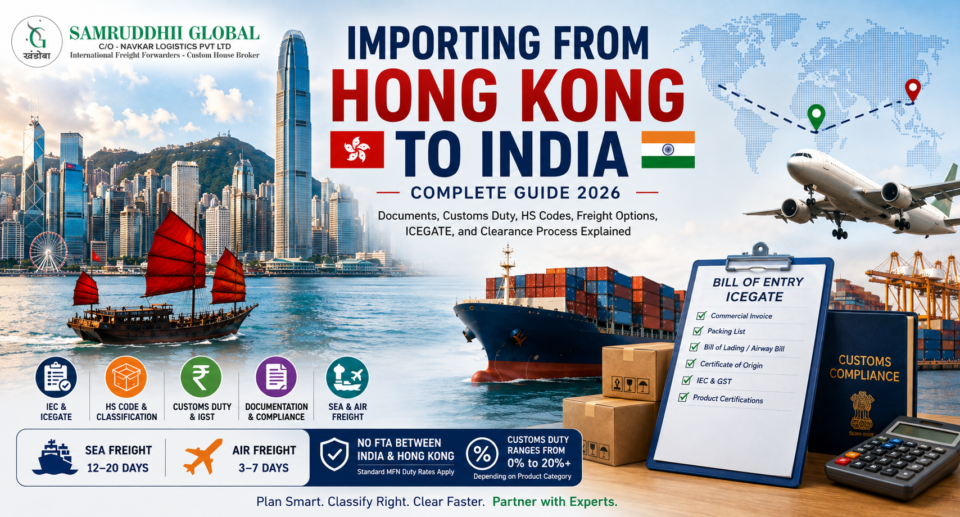
Importing from Hong Kong to India requires an IEC (Import Export Code), correct HS code classification, and a Bill of Entry filed through ICEGATE. There is no Free Trade Agreement between India and Hong Kong, so standard MFN customs duty rates apply (Basic Customs Duty + Social Welfare Surcharge + IGST, varying by product category from roughly 0% to 20%+). Shipments move via Nhava Sheva (sea) or Mumbai Air Cargo (air), with sea freight taking 12–20 days and air freight 3–7 days including clearance.
For importers, the key to controlling cost and avoiding delays is to verify the correct HS code, country of origin, required product approvals, documentation, freight mode, and total landed cost before the shipment leaves Hong Kong.
Why This Guide Exists
Most guides to importing into India focus almost entirely on China. Hong Kong gets treated as an afterthought — usually reduced to a courier or personal-parcel FAQ page buried on a logistics company’s website. But Hong Kong is a distinct trade jurisdiction with its own duty logic, its own role as a transshipment hub, and its own documentation requirements that matter a great deal to commercial importers, not just individuals shipping a single parcel home.
This guide is written from the vantage point of a licensed Customs House Agent — Samruddhii Global, a unit of Navkar Logistics Pvt Ltd, CHA No. 11/473 — operating directly at Nhava Sheva (JNPT) and Mumbai Air Cargo, where a meaningful share of India’s Hong Kong-origin cargo physically clears customs. The goal here isn’t generic advice; it’s the specific mechanics of this trade route, written for business owners, procurement teams, and first-time importers who need to get this right the first time.
Hong Kong as a Trade and Logistics Hub
Before getting into process and duty mechanics, it helps to understand why Hong Kong occupies such an unusual position in global trade — because that context shapes almost every practical decision an importer makes on this route.
Hong Kong is one of the world’s busiest free ports. It levies no export duties on the vast majority of goods leaving its territory, and its customs and documentation systems are built for speed rather than revenue collection. This has made it, for decades, one of the primary re-export and transshipment points for goods manufactured across mainland China, Southeast Asia, and beyond — meaning a shipment “from Hong Kong” doesn’t always mean the goods were manufactured there.
For Indian importers, this cuts two ways:
- Advantage: Hong Kong’s efficient port operations and free-port status mean faster export-side processing than many mainland Chinese ports, and its role as a consolidation hub can simplify sourcing from multiple Chinese suppliers into a single shipment.
- Caution: Because goods routed through Hong Kong may actually originate elsewhere, importers need to verify the true country of origin — this affects certificate of origin accuracy and, for certain product categories, exposure to anti-dumping or safeguard duties that are origin-specific.
Hong Kong is also home to a well-developed trading and logistics ecosystem — sourcing agents, inspection companies, and freight consolidators — which makes it a practical base even for businesses whose actual manufacturing relationships are in Guangdong province or elsewhere in China.
India–Hong Kong Trade at a Glance
Hong Kong is a genuinely significant, if underdiscussed, trade partner for India. According to UN COMTRADE data, India’s imports from Hong Kong totalled roughly $3.2 billion in 2024, dominated by the following categories:
| Category | Approx. 2024 Value (USD) |
| Pearls, precious stones, metals, coins | $2.07 billion |
| Electrical & electronic equipment | $727.9 million |
| Machinery, nuclear reactors, boilers | $133.8 million |
| Optical, photo, technical, medical apparatus | $31.7 million |
| Plastics | $19.7 million |
| Special woven/tufted fabric, lace | $18.8 million |
| Clocks and watches | $16.2 million |
| Paper and paperboard articles | $12.1 million |
| Organic chemicals | $4.9 million |
Within electronics specifically, the largest sub-categories are integrated circuits, apparatus for line telephony/telegraphy, printed circuits, and semiconductor devices — reflecting Hong Kong’s role as a routing point for components manufactured across the Pearl River Delta region. Trade in the reverse direction is even larger: Hong Kong’s imports from India (largely gems, jewellery, and electronics re-exports) run into the billions of dollars annually, underscoring how deeply integrated this trade corridor already is.
Is There a Free Trade Agreement Between India and Hong Kong?
No. This is the single most misunderstood fact among first-time importers on this route, so it’s worth stating plainly and early, before any cost planning happens.
India does not have a Free Trade Agreement (FTA) with Hong Kong. Goods imported from Hong Kong are charged the same Most Favoured Nation (MFN) duty rates as goods from most other non-FTA countries — the same rates that would apply to an identical product imported from mainland China or, in many cases, from countries with no special trade relationship with India at all.
What Hong Kong and India do share is a Double Taxation Avoidance Agreement (DTAA). This is frequently confused with a trade or duty agreement, but it isn’t one — the DTAA governs how income tax is treated for businesses and individuals operating across both jurisdictions, preventing the same income from being taxed twice. It has no bearing on the customs duty charged when your cargo physically clears Indian customs. Importers who assume otherwise, and budget on that assumption, are often surprised by their first landed-cost calculation.
Hong Kong Shipping Address vs Country of Origin: What Importers Must Know
Shipping goods from Hong Kong does not automatically mean that the goods were manufactured in Hong Kong. Because Hong Kong is a major re-export and transshipment hub, products may be manufactured in mainland China or another country and routed through Hong Kong before being shipped to India.
Importers should verify the actual country of origin with their supplier and ensure that commercial documents and any applicable certificate of origin accurately reflect that origin. Country of origin can matter for applicable trade measures, including certain anti-dumping or safeguard duties.
This distinction is particularly important when calculating landed cost and checking compliance before shipment.
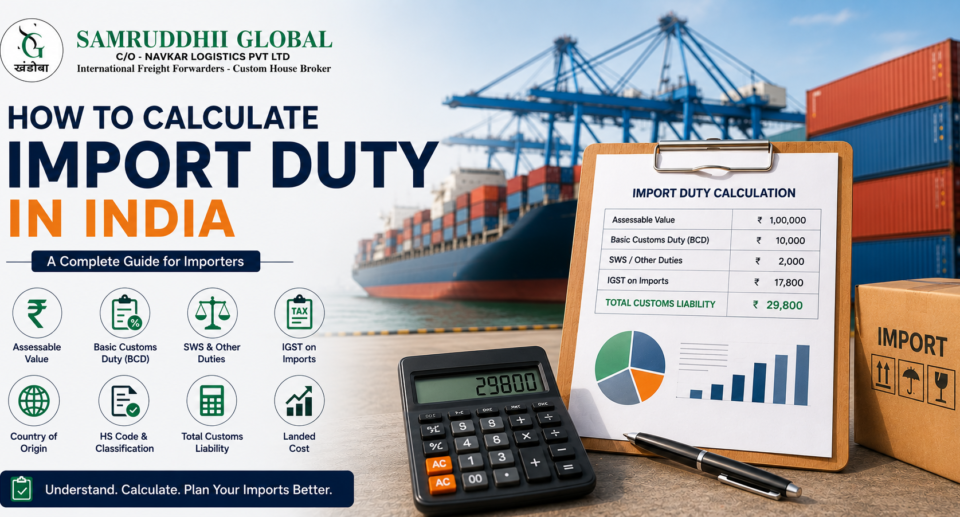
How Indian Customs Duty Is Calculated on Hong Kong Imports
For commercial imports, Indian customs duty is a layered calculation, not a flat percentage applied to invoice value:
- Assessable Value (CIF) — Cost of goods + Insurance + Freight, forming the base for duty calculation
- Basic Customs Duty (BCD) — Applied on the assessable value; the rate depends entirely on the HS code and commonly ranges from 0% to 20%+ depending on product category
- Social Welfare Surcharge (SWS) — Typically 10% of the BCD amount
- IGST — Applied on (Assessable Value + BCD + SWS), not on the product price alone; common IGST slabs are 5%, 12%, 18%, and 28%
Worked example (illustrative): If your goods have a CIF value of ₹1,00,000 and fall under an HS code with 10% BCD and 18% IGST:
- BCD = ₹10,000
- SWS (10% of BCD) = ₹1,000
- IGST taxable value = ₹1,00,000 + ₹10,000 + ₹1,000 = ₹1,11,000
- IGST (18%) = ₹19,980
- Total duty payable ≈ ₹30,980, landed cost ≈ ₹1,30,980
Important: Actual customs duty depends on the applicable HS code, tariff notifications, exemptions, product-specific duties, and other applicable regulations in force on the date of import. The example above is for illustration only and should not be treated as a universal duty rate.
This is separate from the personal-parcel duty rates (some courier services quote a flat ~38.5% for used or new electronics) that apply specifically to individual gift or personal shipments. Commercial imports are assessed on HS code and product category, not a blanket rate — which is precisely why correct classification matters so much.
If your product also falls under an anti-dumping duty or safeguard duty notification — common in categories like steel, certain chemicals, and select electronics components — additional duty layers apply on top of the calculation above, and these notifications are sometimes origin-specific, reinforcing why verifying true origin matters even on the Hong Kong route.
Understanding HS Codes for Hong Kong Imports
Every product entering India is classified under a Harmonized System (HS) code — an internationally standardised numbering system that determines duty rate, IGST slab, and whether any product-specific regulatory approval applies. For the product categories most commonly imported from Hong Kong, a few HS chapters come up repeatedly:
- Chapter 85 — Electrical machinery and electronics (integrated circuits, mobile phone components, batteries)
- Chapter 84 — Machinery, mechanical appliances, and parts
- Chapter 90 — Optical, photographic, medical, and precision instruments
- Chapter 71 — Pearls, precious stones, and metals
- Chapter 91 — Clocks and watches
- Chapter 39 — Plastics and articles thereof
- Chapter 29 — Organic chemicals
Misclassification within these chapters is a common cause of clearance delays and post-clearance duty disputes. A component classified one HS sub-heading away from its correct code can carry a materially different duty rate, or trigger a certification requirement that wasn’t anticipated at the time of shipping. When in doubt, get classification confirmed by your CHA before the shipment leaves Hong Kong, not after it lands.
Step-by-Step: Importing from Hong Kong to India
1. Obtain Your IEC (Import Export Code)
Issued by the DGFT, mandatory for all commercial imports. Without it, you cannot file a Bill of Entry or make international payments for the shipment.
2. Register on ICEGATE
ICEGATE (Indian Customs Electronic Gateway) is where your Bill of Entry gets filed. Link it to your IEC well before your first shipment arrives — doing this in advance, rather than after cargo lands, avoids avoidable day-one delays.
3. Verify Your Hong Kong Supplier and True Origin
As covered above, Hong Kong’s role as a transshipment hub means goods sometimes originate elsewhere. Confirm actual origin with your supplier — it affects certificate of origin accuracy and, in some product categories, anti-dumping duty exposure.
4. Classify Goods with the Correct HS Code
This single step determines your duty rate, your IGST slab, and whether product-specific approvals (BIS, WPC, FSSAI) apply. Get it confirmed before shipping, not after arrival.
5. Choose Your Freight Mode
| Factor | Sea Freight (Nhava Sheva) | Air Freight (Mumbai Air Cargo) |
| Typical transit time | 12–20 days | 3–7 days |
| Best for | Bulk, heavy, non-urgent cargo | High-value, urgent, smaller cargo |
| Cost structure | Lower per-unit for volume | Higher per-kg, faster capital turnaround |
| Common categories | Plastics, machinery, chemicals | Optical/medical instruments, watches, electronics samples |
6. Prepare Documentation
- Commercial invoice
- Packing list
- Bill of Lading (sea) or Airway Bill (air)
- Certificate of origin
- IEC and GST registration proof
- Product-specific certifications where applicable (BIS for electronics, WPC for wireless devices, FSSAI for food)
A practical document checklist for importers:
| Document | Purpose |
| Commercial Invoice | Establishes the transaction value and product details |
| Packing List | Provides package, quantity and shipment details |
| Bill of Lading / Airway Bill | Acts as the transport document |
| Certificate of Origin | Establishes the declared country of origin |
| IEC | Identifies the importer for commercial trade |
| GST registration details | Supports applicable tax and compliance requirements |
| Product certificates | Supports regulatory compliance where applicable |
7. File the Bill of Entry via ICEGATE
Your CHA files this electronically, declaring goods, HS codes, and assessable value. Shipments are routed to either the green channel (minimal checks) or red channel (physical examination) based on risk profiling.
8. Pay Duty and Clear Customs
Duty is paid online through ICEGATE. Once paid and any examination is cleared, customs issues an Out of Charge order and the cargo is released.
9. Final-Mile Delivery
Coordinated transport from the port or air cargo complex to your warehouse — often the most underestimated cost and time variable in the entire import journey, particularly for businesses located
How to Calculate Total Landed Cost for a Hong Kong Import
A useful planning formula is:
Landed Cost = Product Cost + Freight + Insurance + Customs Duty + Port/CFS Charges + CHA Charges + Other Applicable Charges + Inland Transportation
The exact components can vary by shipment, product, freight mode, port, regulatory requirements and applicable charges. Using an all-in estimate before shipment helps an importer compare supplier quotations and freight options on a realistic basis.
Cost Components Beyond Customs Duty
Duty and IGST are only part of your true landed cost. A realistic budget for a Hong Kong shipment should also account for:
- Freight charges — sea or air, quoted per CBM/kg or as a flat container rate
- Marine or air cargo insurance
- CHA/customs brokerage fees — for Bill of Entry filing and clearance coordination
- Port handling and CFS (Container Freight Station) charges, where applicable
- Demurrage and detention — charged if cargo or containers aren’t cleared and returned within free-time limits, and one of the most common sources of unplanned cost for first-time importers
- Inland transportation from port/air cargo complex to final warehouse
Businesses that only budget for product price and headline duty rate are routinely surprised by the gap between quoted cost and actual landed cost. Asking your freight forwarder and CHA for an all-in landed cost estimate upfront — not just a freight quote — is one of the best ways to avoid this.
Common Mistakes Importers Make on the Hong Kong Route
- Assuming Hong Kong goods qualify for preferential duty rates simply because there’s no FTA-related confusion — no such preferential treatment applies
- Confusing DTAA tax benefits with customs duty relief — these are entirely separate legal instruments
- Not verifying true country of origin when goods are transshipped through Hong Kong from mainland China or elsewhere
- Missing product-specific certification, particularly BIS for electronics or WPC for wireless-enabled devices, which can lead to detention regardless of country of origin
- Choosing freight mode on cost alone, without factoring in how transit time affects working capital and inventory planning
- Treating freight forwarding and customs clearance as separate, uncoordinated relationships — this can contribute to significant delays at the Indian end, since Hong Kong’s own export processing rarely causes the bottleneck
Compliance Checklist by Product Category
| Product Category | Likely Certification Requirement |
| Consumer electronics, appliances | BIS certification under applicable Quality Control Order (QCO) |
| Wireless/Bluetooth-enabled devices | WPC (Wireless Planning & Coordination) approval |
| Food products, ingredients | FSSAI clearance |
| Packaged/pre-packed goods | Legal Metrology (LPMC) compliance |
| Medical instruments | Additional regulatory approvals depending on device classification |
| Plastics, electronics (post-consumer) | EPR (Extended Producer Responsibility) registration |
Confirm applicable requirements for your specific HS code before shipment — certification gaps are discovered at the port, not before, far too often.
Why Work With a Licensed CHA for Hong Kong Imports
Hong Kong’s own port and documentation systems move fast — which means any friction on the Indian side becomes the real bottleneck in your supply chain. A licensed Customs House Agent who understands both the freight and customs sides of this specific route helps avoid the two most common failure points: HS code misclassification and disconnected coordination between freight forwarder and customs broker.
Samruddhii Global (Navkar Logistics Pvt Ltd, CHA No. 11/473) is a licensed Customs House Agent with strategic presence at Nhava Sheva (JNPT) and Mumbai Air Cargo, specializing in combined freight forwarding and customs clearance for the China and Hong Kong trade corridors. Our team manages HS code classification, documentation, duty assessment, and end-to-end clearance under a single point of accountability — so your Hong Kong shipments move as one coordinated process rather than a series of disconnected handoffs.
Planning to Import from Hong Kong to India?
Get your HS code, documentation, customs duty and freight requirements reviewed before your shipment leaves Hong Kong. Samruddhii Global can coordinate freight forwarding and customs clearance through Nhava Sheva and Mumbai Air Cargo.