
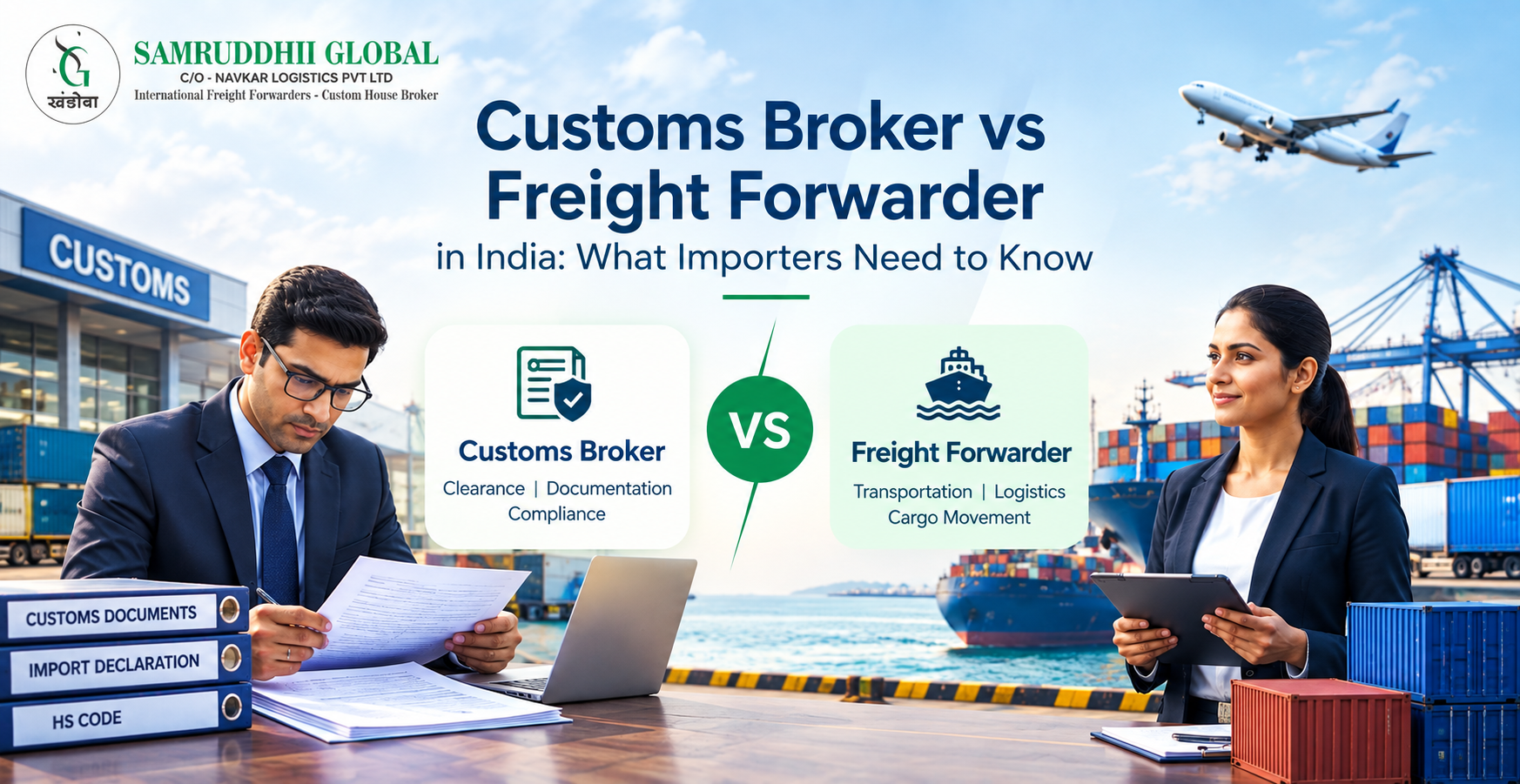
When importing goods into India, several parties may be involved before a shipment reaches the importer’s warehouse. Two of the most commonly involved are a customs broker and a freight forwarder.
Although their services can overlap, they are not the same.
A freight forwarder primarily coordinates the movement of cargo from the supplier to the destination through transportation and logistics arrangements. A customs broker primarily assists with customs clearance, documentation and applicable customs requirements when goods enter India.
What Is a Customs Broker in India?
A customs broker is a professional service provider that assists importers and exporters with applicable customs procedures, documentation and clearance requirements.
For an importer, the customs broker’s role becomes particularly relevant when goods arrive in India and need to complete the applicable customs formalities before release.
Depending on the shipment, the broker may assist with documentation, import declarations, classification-related matters, valuation-related coordination, customs queries, examination requirements and other activities associated with customs clearance.
The exact scope depends on the nature of the goods, transaction, port, documentation and applicable regulations.
What Does a Customs Broker Do?
A customs broker may assist with:
- Reviewing and coordinating customs-related documentation
- Supporting import declarations and Bill of Entry-related processes
- HS classification-related assistance
- Coordination relating to customs valuation
- Coordination of applicable duty-related information
- Customs query and communication support
- Examination or inspection coordination where applicable
- Coordination with relevant customs stakeholders
- Supporting the customs clearance and release process
The primary focus is therefore customs clearance and related compliance coordination, rather than arranging the international transportation of the cargo.
For businesses looking for customs broker services, it is important to establish the provider’s exact responsibilities before the shipment is booked.
What Is a Freight Forwarder?
A freight forwarder coordinates the transportation and logistics of cargo between the origin and destination.
For an international import shipment, this can involve coordinating the movement of goods from an overseas supplier to India through ocean, air or another applicable transportation method.
A freight forwarder’s role can begin before the cargo leaves the supplier and continue through transportation, arrival coordination and, depending on the service arrangement, delivery.
What Does a Freight Forwarder Do?
Depending on the agreed scope, a freight forwarder may coordinate:
- Ocean or air freight bookings
- Shipping-line or airline coordination
- Transportation routes and schedules
- Shipment documentation
- Origin cargo coordination
- Shipment tracking and status updates
- Consolidation or deconsolidation where applicable
- Destination coordination
- Delivery arrangements
The primary objective is to coordinate the movement of cargo from origin to destination.
This makes freight forwarding different from customs brokerage, although both functions frequently interact during an international shipment.
Customs Broker vs Freight Forwarder: Key Differences
The difference becomes easier to understand when the responsibilities are viewed side by side.
| Factor | Customs Broker | Freight Forwarder |
| Primary role | Customs clearance and compliance coordination | Cargo movement and logistics coordination |
| Main focus | Customs procedures and documentation | International transportation |
| Customs documentation | Core area | May support or coordinate |
| Import declarations | Core area | May coordinate with the relevant party |
| Freight booking | Not normally the primary function | Core function |
| Carrier coordination | Related to customs/arrival requirements | Core activity |
| Customs clearance | Core service | May offer or arrange it |
| Shipment tracking | Clearance-related coordination | Common logistics function |
| Delivery coordination | May support after release | Often part of the service |
| Main objective | Facilitate the customs clearance process | Coordinate movement of goods |
The key distinction
A freight forwarder is primarily concerned with where the cargo is, how it will move and how the transportation will be coordinated.
A customs broker is primarily concerned with the customs process that applies when goods are imported or exported.
However, this distinction is about their primary functions, not a rigid rule that every company offers only one type of service.
Some freight forwarders also provide customs clearance. Some logistics providers coordinate customs clearance through a separate customs broker. Others provide an integrated logistics solution.
That is why importers should evaluate the actual service scope, rather than relying only on the provider’s title.
Customs Clearance vs Freight Forwarding: How Are They Connected?
Customs clearance and freight forwarding are separate functions within the same international shipment.
A simplified import journey looks like this:
Supplier → Freight Booking → International Transportation → India Arrival → Customs Clearance → Customs Release → Final Delivery
Freight Forwarding
The freight forwarder generally coordinates the movement of the shipment.
This can include freight booking, carrier coordination, transportation schedules, origin communication, tracking and destination coordination.
Customs Clearance
The customs broker generally coordinates the customs side of the shipment.
This can include customs documentation, declarations, classification-related assistance, customs queries, examination coordination and other applicable clearance activities.
After Customs Release
Once the applicable customs process is completed and the cargo is released, the shipment can move toward its final destination.
This is why the two services are different but closely connected.
A shipment may be physically moving through an international logistics network while simultaneously requiring documentation and customs coordination.
Do Importers Need Both a Customs Broker and a Freight Forwarder?
There is no single arrangement that applies to every importer.
The answer depends on the shipment, the provider’s service scope and what the importer has already arranged.
If You Already Have a Freight Forwarder
If your freight forwarder handles only transportation and logistics, you may need a separate customs broker for the customs clearance process.
Before the shipment arrives in India, confirm:
- Who will handle customs clearance?
- Who will coordinate the customs documentation?
- Who will respond to customs queries?
- Who will coordinate examination requirements, where applicable?
- Who will coordinate cargo release?
- Which charges are included in the quoted service?
This prevents a common problem: assuming that another party is responsible for customs simply because a freight forwarder has already been appointed.
If You Already Have a Customs Broker
A customs broker can manage or coordinate the customs side of the shipment, but international transportation may still need to be arranged separately.
A freight forwarder may be required for:
- Ocean or air freight booking
- Carrier coordination
- Origin logistics
- Transportation planning
- Shipment tracking
- Destination coordination
- Delivery arrangements
If One Provider Offers Both
Some logistics companies offer or coordinate both freight forwarding and customs clearance.
For an importer, this can provide a single point of coordination across multiple stages of the shipment.
However, an integrated service does not necessarily mean that every activity or charge is included.
Before booking, clarify:
Service Scope → Documentation → Freight → Customs Clearance → Destination Charges → Delivery
This makes the commercial arrangement easier to understand and reduces responsibility gaps.
How Do Customs Brokers and Freight Forwarders Work Together?
An international shipment normally involves several parties, not just the importer and logistics provider.
A simplified responsibility map is:
| Party | Typical Responsibility |
| Supplier | Goods preparation and commercial documentation |
| Importer | Commercial information, instructions, documents and applicable payments |
| Freight Forwarder | Freight booking and transportation coordination |
| Shipping Line / Airline | Physical transportation |
| Customs Broker | Customs documentation and clearance coordination |
| Customs Authorities | Applicable assessment, examination and release processes |
| Transport Provider | Post-release movement to the final destination |
These responsibilities are interconnected.
For example, incorrect information in a commercial document can affect customs processing. A transportation delay can change arrival planning. A customs query can affect cargo release. A delivery issue can occur after customs clearance has already been completed.
The providers may have different roles, but the shipment remains one connected process.
Example: Importing Goods From China Through JNPT
Consider an Indian manufacturer importing machinery from China through Jawaharlal Nehru Port (JNPT), Nhava Sheva.
1. Supplier Prepares the Shipment
The Chinese supplier prepares the goods and relevant commercial and shipping documentation.
The importer should ensure that the information supplied for the transaction is accurate and consistent.
2. Freight Is Arranged
The importer or its logistics provider arranges transportation from China to India.
A freight forwarder may coordinate the ocean freight booking, carrier, sailing schedule and shipment information.
3. Cargo Moves From China to India
The shipment travels toward India according to the selected transportation arrangement.
During this stage, the freight forwarder may coordinate with the supplier, shipping line and destination-side parties and provide shipment status information.
4. Cargo Arrives at JNPT
When the shipment arrives at JNPT, the customs clearance process becomes an important part of the import procedure.
The customs broker can assist with the applicable documentation, declarations and clearance requirements within the agreed service scope.
5. Customs Processing Takes Place
Depending on the shipment, customs processing may involve document review, assessment, examination or other applicable requirements.
The customs broker coordinates the relevant activities, while the customs authorities carry out the applicable regulatory processes.
6. Cargo Is Released and Moves to the Destination
After the applicable customs process is completed and the cargo is released, the shipment can proceed to the importer’s warehouse, factory or other designated destination.
The roles can therefore be summarized as:
Freight Forwarder → Coordinates international cargo movement
Customs Broker → Coordinates customs clearance
Importer → Provides accurate information, documents, instructions and fulfils applicable responsibilities
This distinction is particularly useful for businesses regularly importing through JNPT/Nhava Sheva.
Common Mistakes Importers Should Avoid
1. Assuming the Freight Forwarder Handles Everything
A freight forwarder may provide or arrange customs clearance, but this should never be assumed without confirmation.
Always establish whether customs clearance is included in the service.
2. Discussing Customs Only After Cargo Arrives
Customs documentation and shipment information should be reviewed before arrival wherever possible.
Early coordination gives the importer and service providers more time to identify missing or inconsistent information.
3. Comparing Providers Only on Freight Rates
The quoted freight rate is only one part of the overall logistics cost.
Depending on the shipment, businesses may also need to consider handling, documentation, destination, customs-related and delivery charges.
4. Not Defining Responsibilities
Before booking a shipment, establish responsibility for:
Freight → Documentation → Customs Clearance → Cargo Release → Delivery
A clear responsibility structure can reduce confusion between the importer, freight forwarder and customs broker.
5. Treating Customs Clearance as an Afterthought
Customs clearance should form part of shipment planning from the beginning.
The nature of the goods, documentation, classification, origin, destination and applicable requirements can all influence the clearance process.
How to Choose a Customs Broker in India
When evaluating a customs broker, importers should consider factors such as:
- Experience with the relevant port or airport
- Familiarity with the type of goods being imported
- Customs documentation processes
- Communication and response time
- Ability to coordinate customs queries
- Understanding of shipment-specific requirements
- Transparency of service charges
- Experience with the relevant trade route or industry
For businesses importing through JNPT/Nhava Sheva, experience with the relevant port and customs environment can be an important consideration.
Businesses can also review the provider’s ability to coordinate with freight forwarders, transport providers and other parties involved in the shipment.
How to Choose a Freight Forwarder in India
When evaluating a freight forwarder, importers can consider:
- Ocean and/or air freight capabilities
- Carrier and routing options
- Origin coordination
- Destination support
- Shipment tracking
- Transit-time communication
- Documentation support
- Delivery coordination
- Transparency of freight and destination charges
Instead of comparing only the headline freight rate, evaluate the complete service scope and expected logistics cost.
A provider that communicates clearly about routing, charges, documentation and responsibilities can make shipment management easier.
Why This Difference Matters for Indian Importers
For a first-time importer, international shipping can appear to be one simple process:
Supplier → India → Warehouse
In practice, it involves multiple connected stages:
Commercial Transaction → Freight Booking → International Transportation → Port Arrival → Customs Clearance → Cargo Release → Inland Delivery
Different parties may be responsible for different stages.
The freight forwarder primarily coordinates the logistics and movement of cargo.
The customs broker primarily coordinates the customs clearance side.
The importer connects these activities by providing accurate commercial information, documentation, instructions and other required inputs.
Understanding this structure helps importers identify the right service provider, define responsibilities before shipment arrival and communicate more effectively when an issue occurs.
Conclusion
A customs broker and a freight forwarder are different service providers with different primary responsibilities, even though both may be involved in the same international shipment.
A freight forwarder primarily coordinates transportation and cargo movement.
A customs broker primarily assists with customs clearance, documentation and applicable customs requirements.
For importers, the practical question is therefore not simply whether they need a customs broker or a freight forwarder.
The more useful question is:
“Who is responsible for each stage of my shipment?”
Once freight, documentation, customs clearance, cargo release and delivery responsibilities are clearly defined, the import process becomes easier to coordinate.
For businesses importing through JNPT/Nhava Sheva, Mumbai, this distinction can be particularly useful when working with multiple logistics partners or selecting a provider that can coordinate both freight forwarding and customs clearance.
Ultimately, customs brokerage and freight forwarding should not be viewed as competing services. They are different functions that work together to move an international shipment from the supplier to its final destination.