How to Calculate Import Duty in India: Complete Guide for Importers

Importing goods into India involves more than paying an overseas supplier and arranging international transportation. Businesses must also account for customs duties, IGST, freight, insurance, port-related expenses, customs clearance charges, and other applicable costs.
Understanding how to calculate import duty in India helps importers estimate the financial impact of a shipment before placing an order. An accurate estimate supports procurement decisions, pricing, budgeting, landed-cost analysis, and overall import planning.
The amount payable varies by product and transaction. Customs liability can depend on the HS Code, assessable value, country of origin, applicable tariff rate, exemptions, concessions, product-specific notifications, and other customs provisions.
What Is Import Duty in India?
Import duty refers to customs duties and applicable taxes imposed on goods entering India. The amount payable depends on how the goods are classified and valued under the customs provisions applicable to the transaction.
Depending on the product and applicable provisions, an importer may need to consider:
- Basic Customs Duty (BCD)
- Social Welfare Surcharge (SWS), where applicable
- IGST on imports
- Anti-dumping duty or safeguard duty, where applicable
- Other product-specific customs measures
These customs duties and taxes are separate from broader import expenses such as freight, insurance, port charges, customs clearance, and inland transportation.
Import Duty vs. Landed Cost
Import duty is only one part of the overall cost of importing goods.
A simplified landed-cost calculation is:
Product Cost + Freight + Insurance + Customs Duties and Taxes + Port/Handling Charges + Clearance Costs + Inland Transportation = Landed Cost
Understanding this distinction helps businesses calculate the actual cost of acquiring imported goods rather than relying only on the customs tax payable.
What Determines Import Duty on Imported Goods?
There is no single customs duty rate for all imported products. The applicable treatment is determined by several factors.
1. HS Code and Product Classification
The HS Code identifies the tariff classification of an imported product and is a key factor in determining the applicable customs treatment.
A general description such as “machinery,” “electronic equipment,” or “industrial parts” may not be sufficient. Depending on the product, classification may consider:
- Function
- Material or composition
- Technical specifications
- Model or type
- Intended use
- Physical characteristics
The classification should accurately represent the goods and follow the applicable tariff rules. An incorrect HS Code can result in an inaccurate duty estimate and may lead to customs queries, reassessment, or clearance delays.
2. Assessable Value
Customs duty is not necessarily calculated by applying a percentage directly to the supplier’s invoice value.
The assessable value is determined under the applicable customs valuation provisions. Depending on the transaction, the valuation may involve the transaction value and other includible elements prescribed under the relevant rules.
Establishing the correct customs value is therefore an essential part of the calculation.
3. Country of Origin
The country of origin can affect customs treatment, particularly when preferential tariff arrangements are available.
Preferential treatment cannot be assumed solely because goods are shipped from a particular country. Eligibility depends on the applicable rules of origin, supporting documentation, and procedural requirements.
4. Tariff Rates and Customs Notifications
The applicable duty treatment depends on the tariff entry and customs provisions in force at the time of import.
Importers should check for:
- Exemptions
- Concessions
- Preferential tariff treatment
- Anti-dumping measures
- Safeguard measures
- Product-specific duties
- Other applicable notifications
Using an outdated rate or notification can result in an incorrect cost estimate.
Information Required Before Calculating Import Duty
Before estimating customs liability, the importer should have accurate information about the product and shipment.
Product Details
The commercial and shipping documents should clearly identify the goods. Depending on the product, useful details may include the product name, function, material, technical specifications, model, intended use, and quantity.
These details help establish the appropriate tariff classification.
Customs Classification
The appropriate HS Code should be established from the actual characteristics of the goods and the applicable classification rules.
The objective should be correct classification, not selecting a tariff code simply because it carries a lower duty rate.
Country of Origin
Confirm the actual country of origin, particularly if preferential tariff treatment may be available.
Customs Value
Review the commercial invoice and relevant transaction information needed to establish the customs value under the applicable valuation provisions.
Applicable Rates
Identify the current BCD, SWS where relevant, IGST, and any additional duties or measures applicable to the shipment.
Key Components of Import Duty Calculation
Once the classification and customs value are established, the applicable customs components can be evaluated.
Basic Customs Duty (BCD)
Basic Customs Duty (BCD) is a principal customs duty that may apply to imported goods.
For illustration:
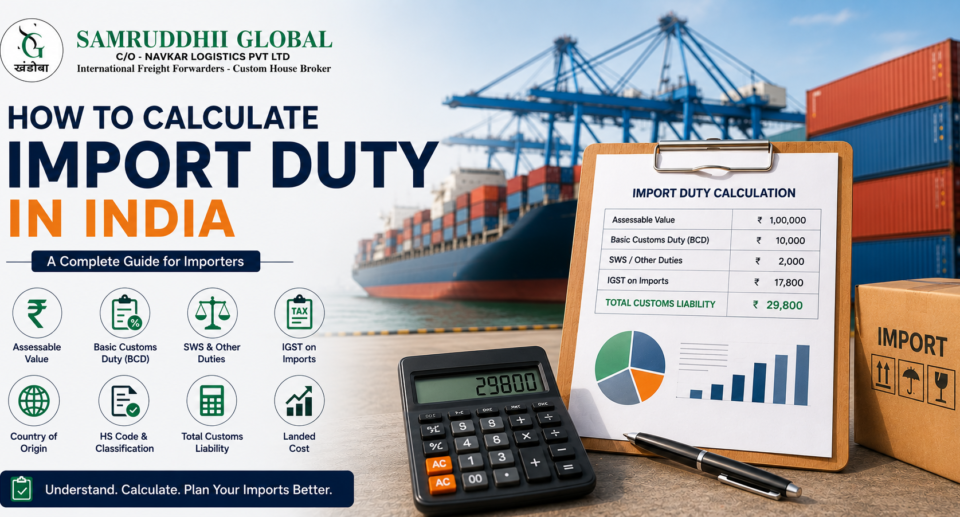
Assessable Value = ₹1,00,000
BCD Rate = 10%
BCD = ₹1,00,000 × 10% = ₹10,000
The actual BCD rate depends on the applicable tariff classification and current customs provisions.
Social Welfare Surcharge
Social Welfare Surcharge (SWS) may apply to eligible imports under the relevant provisions.
Its applicability and calculation should be determined for the specific customs entry.
Other Applicable Duties
Certain products may attract additional duties or trade-remedy measures, including:
- Anti-dumping duty
- Safeguard duty
- Other applicable duties or cesses
- Product-specific measures
Their applicability depends on the product, classification, origin, and relevant notifications.
IGST on Imports
Integrated Goods and Services Tax (IGST) may apply to imported goods.
The applicable rate depends on the tax classification of the product. Import IGST is not calculated simply on the supplier’s invoice value; the prescribed customs tax base and relevant customs components must be considered.
How to Calculate Import Duty in India Step by Step
The calculation can be approached through the following six steps.
Step 1: Classify the Product
Determine the appropriate HS Code using the actual characteristics of the goods and the applicable tariff classification rules.
Step 2: Determine the Assessable Value
Establish the customs value according to the applicable valuation provisions and relevant transaction information.
Step 3: Calculate Basic Customs Duty
Apply the applicable BCD rate to the assessable value.
For example:
Assessable Value = ₹1,00,000
BCD Rate = 10%
BCD Payable = ₹10,000
Step 4: Check Additional Customs Measures
Determine whether SWS, anti-dumping duty, safeguard duty, other measures, exemptions, concessions, or preferential tariff treatment apply.
Step 5: Calculate IGST
Identify the applicable IGST rate and calculate it using the prescribed customs tax base and applicable duty components.
Step 6: Determine Total Customs Liability
Add the applicable customs duties and taxes.
A simplified representation is:
BCD + Applicable Surcharge/Other Duties + IGST = Total Customs Duties and Taxes
The actual calculation may vary according to the product, valuation, tariff treatment, exemptions, concessions, and other applicable provisions.
Import Duty Calculation Example
Consider a hypothetical import with:
- Assessable Value: ₹1,00,000
- BCD Rate: 10%
- Illustrative IGST Rate: 18%
BCD Calculation
₹1,00,000 × 10% = ₹10,000
For illustration only, assume the relevant IGST calculation base after considering the applicable customs components is ₹1,10,000.
IGST Calculation
₹1,10,000 × 18% = ₹19,800
Illustrative Customs Tax Liability
BCD = ₹10,000
IGST = ₹19,800
Illustrative Total = ₹29,800
This example demonstrates the calculation sequence only. It should not be treated as a final duty quotation or a universal formula for every import.
For an actual shipment, the applicable HS Code, customs valuation, tariff rates, country of origin, exemptions, concessions, and current notifications should be verified.
Example: Importing Machinery From China to India
Consider an Indian business importing machinery from China.
Before placing the order, the importer should establish:
- Product description and technical specifications
- Correct HS Code
- Country of origin
- Customs value
- Applicable BCD
- Other customs duties or trade measures
- Applicable IGST rate
- Preferential tariff eligibility, if relevant
- Required import documentation
The cost-planning process can be represented as:
Product Details → HS Code → Customs Valuation → Applicable Duties → IGST → Customs Tax Liability → Landed Cost
This gives the importer a clearer view of the potential financial impact before the shipment reaches India.
Common Import Duty Calculation Mistakes
1. Using the Wrong HS Code
Incorrect classification can result in an inaccurate duty estimate and create customs compliance issues.
2. Assuming Invoice Value Equals Assessable Value
The supplier’s invoice is an important commercial document, but customs valuation must be determined under the applicable valuation provisions.
3. Using an Outdated Duty Rate
Tariff rates, exemptions, and other measures can change. A rate used for an earlier shipment may not apply to a later import.
4. Ignoring Additional Duties
Considering only BCD and IGST without checking other applicable measures can result in an incomplete estimate.
5. Assuming Preferential Duty Automatically Applies
Shipment from a particular country does not by itself establish eligibility for preferential treatment. The relevant rules and documentation must be satisfied.
6. Confusing Import Duty With Landed Cost
Customs duties are only part of the overall import expense. Freight, insurance, port charges, clearance, and inland transportation can also affect the final cost.
7. Relying Entirely on Generic Online Calculators
Online calculators can provide preliminary estimates, but they may not reflect product-specific notifications, exemptions, valuation considerations, or trade-remedy measures.
For important commercial decisions, current and authoritative customs provisions should be verified.
How Can Importers Optimize Import Costs Legally?
Import-cost optimization should focus on compliance, accurate planning, and avoiding unnecessary expenses, rather than attempting to avoid legally payable duties.
Use Accurate HS Classification
Correct classification helps ensure that goods are assessed under the appropriate tariff provisions.
Review Exemptions and Concessions
Where a valid exemption or concession is available, verify the eligibility conditions before making a claim.
Check Preferential Tariff Eligibility
Where an applicable trade arrangement provides preferential treatment, verify the rules of origin and required documentation before including the benefit in the cost estimate.
Maintain Accurate Documentation
Consistent invoices, product descriptions, shipping documents, and supporting records can reduce avoidable clarification and processing issues.
Review Customs Valuation
Accurate valuation information can reduce the risk of disputes, reassessment, and unexpected customs costs.
The objective should always be accurate, transparent, and compliant customs assessment.
Import Duty Calculation Checklist for Importers
Before finalizing an import, review:
- Product description and specifications
- Correct HS Code
- Country of origin
- Customs or assessable value
- Applicable BCD
- SWS, where applicable
- Other applicable duties
- IGST
- Exemptions or concessions
- Preferential tariff eligibility
- Current customs notifications
- Estimated landed cost
A practical workflow is:
Product Details → HS Code → Customs Value → Applicable Duties → IGST → Total Customs Liability → Landed Cost
When Should You Consult a Customs Broker?
Professional customs assistance can be useful when an import involves complex classification, valuation questions, multiple regulatory requirements, or significant financial exposure.
Consider consulting a customs broker or customs professional when:
- The product has a complex HS classification
- The shipment has significant commercial value
- Multiple duties or trade measures may apply
- Customs valuation is unclear
- Preferential tariff treatment is being considered
- Customs has raised a query or reassessment
- The importer is unfamiliar with Indian customs procedures
- Accurate duty estimation is important for procurement or pricing
A customs broker can assist with documentation, tariff classification, customs procedures, and coordination during the clearance process within the applicable legal and service framework.
For businesses importing or exporting through Indian ports and cargo gateways, Samruddhii Global provides customs clearance and freight forwarding support for import and export shipments.
Conclusion
Calculating import duty in India requires more than applying a percentage to the supplier’s invoice value.
The process begins with correct product classification and customs valuation, followed by identification of the applicable BCD, other customs components, and IGST, along with any eligible exemptions, concessions, or preferential tariff treatment.
In practice, the importer should establish the correct classification and customs value first, then verify the applicable duties and taxes before estimating the final import cost.
Estimating these costs before placing an order can help importers make better decisions about budgeting, procurement, pricing, and profitability.
Where classification, valuation, tariff treatment, or customs procedures are complex, professional customs assistance can help businesses manage the clearance process efficiently while maintaining proper customs compliance.
Need Help Calculating Import Duty in India?
Import duty calculation can become complex when HS classification, customs valuation, applicable duties, IGST, exemptions, or preferential tariff treatment are involved.
Samruddhii Global provides customs clearance and freight forwarding support for businesses importing and exporting through Indian ports and cargo gateways.
Get professional support for your import shipment and plan your customs costs with greater clarity.
Get Import Duty Assistance