How to Import from China to India via JNPT Mumbai: Step-by-Step Guide (2026)

China continues to be one of India’s largest trading partners, supplying machinery, electronics, industrial equipment, chemicals, textiles, furniture, automotive parts, and many other products. Businesses of all sizes choose to import from China to India because of competitive pricing, a wide supplier base, and extensive manufacturing capabilities.
For importers using sea cargo, Jawaharlal Nehru Port Trust (JNPT), also known as Nhava Sheva Port, is one of India’s busiest container ports. It handles a significant share of the country’s containerized imports and offers efficient connectivity to major industrial and commercial hubs.
However, importing goods involves more than selecting a supplier and arranging transportation. Importers must complete documentation, comply with customs regulations, pay applicable duties, and coordinate with logistics partners to ensure timely cargo release.
Why Choose JNPT Mumbai for Imports?
JNPT Mumbai is India’s leading container port and plays a crucial role in international trade. Importers prefer JNPT because of its modern infrastructure, regular shipping schedules, and strong connectivity with inland transport networks.
Some advantages include:
- High container handling capacity
- Frequent vessel services from Chinese ports like Shanghai, Shenzhen, Guangzhou, and Hong Kong
- Access to experienced customs brokers and freight forwarders in Mumbai
- Connectivity by road and rail to all major industrial hubs
- Faster cargo movement under India’s 2026 faceless assessment system
Many businesses choose JNPT for importing commercial cargo due to its well-established ecosystem of shipping lines, freight forwarders, and licensed CHA agents.
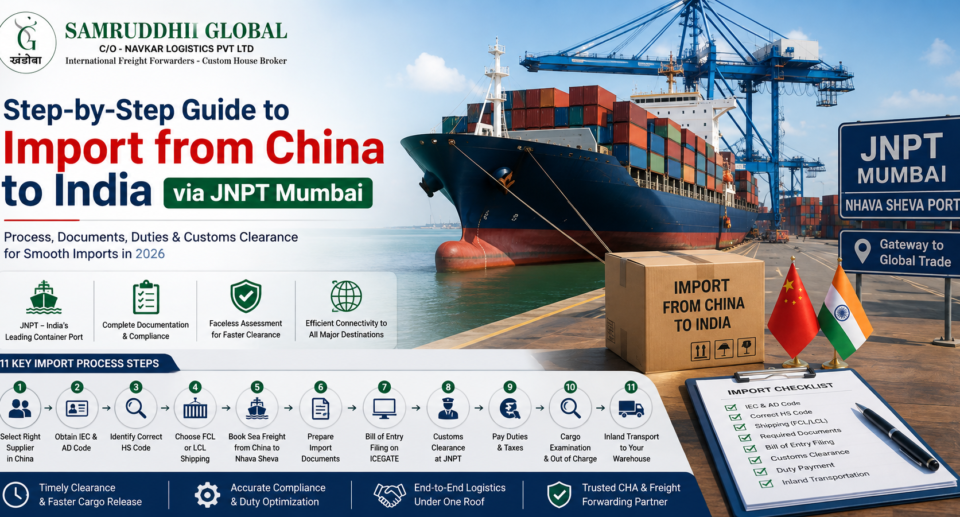
Step 1: Select the Right Supplier in China
The import process begins with selecting a reliable supplier. Before placing an order:
- Verify the supplier’s business credentials and export license
- Request product samples and confirm specifications
- Discuss packaging requirements (ensure ISPM-15 compliance for wooden packaging)
- Agree on production and dispatch timelines
- Finalize payment terms
- Agree on applicable Incoterms — FOB, CIF, or EXW — before confirming the order
Conducting supplier verification helps reduce the risk of quality issues, shipment delays, and disputes.
Step 2: Obtain an Import Export Code (IEC) and AD Code
Import Export Code (IEC)
An IEC issued by DGFT is mandatory for all commercial imports into India. Without an IEC, customs clearance cannot be completed. Application is done online on the DGFT portal and typically takes 2–3 working days.
Businesses should also ensure they have:
- GST Registration
- PAN
- Bank Account with authorized import documentation
AD Code — Authorised Dealer Code
Your bank’s AD Code must be registered and linked to your port of import (JNPT) on the ICEGATE portal. This is a one-time process and is essential for all Bill of Entry filings. A licensed CHA like Samruddhii Global can assist you with this registration quickly.
Step 3: Identify the Correct HS Code for Your Product
The Harmonized System (HS) Code is an internationally standardized classification that determines:
- The applicable Basic Customs Duty (BCD) rate
- Whether your product requires mandatory certifications like BIS, FSSAI, WPC-ETA, or CDSCO approval
- Whether the product falls under any restricted or prohibited category under India’s Foreign Trade Policy
- Whether Anti-Dumping Duty (ADD) applies on Chinese-origin goods in your category
Getting the HS code wrong is one of the most common and costly mistakes in importing. An incorrect classification can result in excess duty payment, cargo holds, or re-assessment orders. Always verify with your CHA before placing the order with your supplier.
Step 4: Decide Between FCL and LCL Shipping
One of the most important decisions while planning to import from China is selecting the right shipping method.
Full Container Load (FCL)
FCL is suitable when your cargo fills an entire 20ft or 40ft container.
Advantages:
- Faster transit and lower handling risk
- Better cargo security
- Cost-effective for large volume shipments
Less than Container Load (LCL)
LCL is ideal for smaller shipments that do not require a full container. Cargo is consolidated with other importers’ goods.
Benefits:
- Lower shipping cost for small volumes
- Flexible for new importers testing new products
- Suitable for sample or trial orders
LCL shipments involve additional consolidation and deconsolidation time, which may slightly increase total transit time.
Choosing between FCL and LCL depends on cargo volume, urgency, and budget. Your freight forwarder can help you decide based on current shipping rates and vessel schedules.
Step 5: Book Sea Freight from China to Nhava Sheva
After production is complete, the shipment is booked with a shipping line or freight forwarder. Major Chinese export ports for India-bound cargo include:
- Shanghai — largest port, wide vessel options
- Shenzhen / Yantian — ideal for South China manufacturing hubs
- Guangzhou / Nansha — strong for consumer goods and electronics
- Ningbo, Qingdao, Xiamen, Tianjin — regional manufacturing zones
- Hong Kong — major transshipment hub
Cargo is transported by sea to Nhava Sheva (JNPT Mumbai), with typical transit times of 10–18 days depending on the shipping line and route.
A freight forwarder coordinates export booking, container stuffing, documentation, cargo tracking, and arrival notifications.
Step 6: Prepare the Required Import Documents
Accurate documentation is the backbone of smooth customs clearance. Missing or inconsistent documents are the single biggest cause of cargo delays at JNPT.
Standard documents required:
| Document | Purpose |
| Commercial Invoice | Declares value, quantity, and description of goods |
| Packing List | Details packaging, weight, and dimensions |
| Bill of Lading | Proof of shipment issued by the carrier |
| Certificate of Origin | Confirms country of manufacture |
| Import General Manifest (IGM) | Filed by shipping line on ICEGATE upon vessel arrival |
| Bill of Entry | Filed by CHA on ICEGATE — the core import declaration |
| Insurance Certificate | Required for CIF-based shipments |
| IEC and GST Details | Mandatory for customs filing |
Additional product-specific documents may include:
- BIS Certificate — for electronics, steel, toys, cement, and other notified products
- FSSAI License — for food and food-contact products
- WPC-ETA Approval — for wireless or Bluetooth devices
- Drug License / CDSCO Approval — for pharmaceutical products
- NOC from MOEF — for environmentally restricted goods
- SIMS / PIMS Registration — for steel and chemical imports
Always verify document consistency before shipment arrival. Errors in value, quantity, or description can trigger customs examination.
Step 7: Bill of Entry Filing in India
The Bill of Entry (BoE) is one of the most important customs documents. It is a legal declaration submitted electronically to Indian Customs through the ICEGATE system.
A Bill of Entry contains:
- Importer information and IEC
- Product description and HS Code
- Quantity and invoice value (CIF basis)
- Country of origin
- Duty calculation details
- Port and vessel details
Filing is typically done before or immediately after vessel arrival. Accuracy at this stage is critical — errors in HS code classification or valuation can trigger examination orders, reassessment, or penalties.
Your licensed CHA handles the entire ICEGATE filing process, ensuring all details are complete and compliant.
Step 8: Customs Clearance at JNPT Mumbai
After the Bill of Entry is filed, the shipment enters the customs clearance process at JNPT. India’s customs uses an AI-driven Risk Management System (RMS) to assess each shipment and assign it to a risk channel:
- 🟢 Green Channel — Low-risk cargo. Auto Out of Charge (OOC) issued automatically. No physical examination.
- 🟡 Yellow Channel — Document verification only. No physical examination required.
- 🔴 Red Channel — Physical examination of cargo by a customs officer at the port.
- 🔵 Blue Channel — Goods released but subject to post-clearance audit.
In 2026, the CBIC’s Circular No. 06/2026 expanded the Auto OOC facility — meaning compliant importers with accurate documentation can receive automatic clearance without officer intervention. Maintaining clean compliance records and working with an experienced CHA is the best way to consistently achieve Green Channel status.
Step 9: Pay Customs Duty and Applicable Taxes
Before cargo can be released, all applicable duties must be paid electronically through the ICEGATE payment gateway.
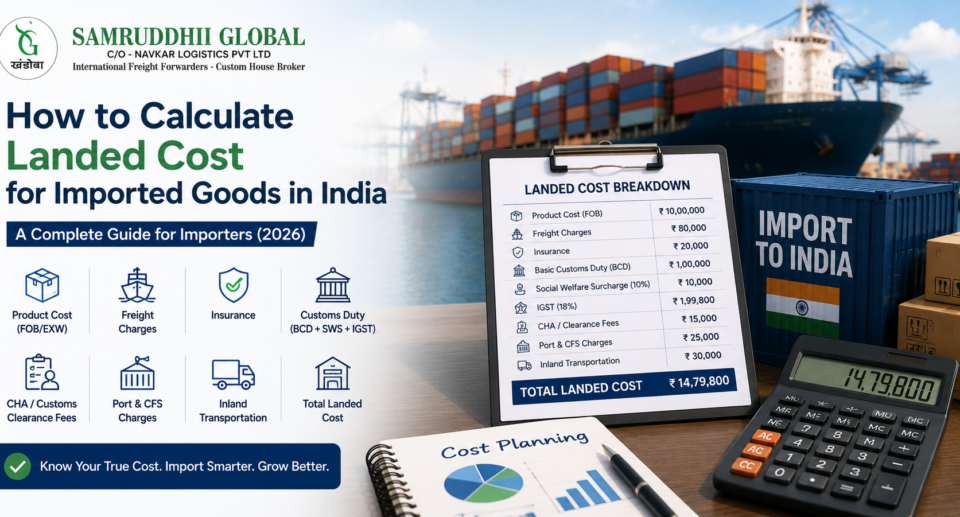
Duties applicable on imports from China may include:
- Basic Customs Duty (BCD) — varies by HS code
- Social Welfare Surcharge (SWS) — 10% of BCD
- Integrated GST (IGST) — typically 5%, 12%, or 18%
- Anti-Dumping Duty (ADD) — applicable on specific Chinese-origin product categories
- Compensation Cess — on certain goods like tobacco and automobiles
- Safeguard Duty — if notified for specific import surges
Duty rates vary according to the product’s HS Code and current government notifications. Always confirm the latest duty structure before placing your order to estimate your total landed cost accurately.
Step 10: Cargo Examination and Out of Charge
For shipments assigned to Red or Blue channel, customs officers at JNPT physically verify:
- Product quantity and packaging
- Product description and labels
- Country of origin marking
- Compliance with applicable standards
If no discrepancies are found and duties have been paid, customs issues the Out of Charge (OOC) — the final clearance that allows your cargo to be released from the port.
Step 11: Inland Transportation to Your Warehouse
After OOC, cargo moves through terminal handling at JNPT, and the shipping line releases the Delivery Order (DO) after settlement of freight charges. From there, your goods are transported to the final destination.
Transportation options include:
- Container trailers (FTL — Full Truck Load)
- Part loads (LTL — Less than Truck Load)
- Rail transport for long-distance movement
- Multimodal logistics for SEZ or ICD deliveries
Arrange inland transportation in advance to avoid port storage charges, which accumulate daily after the free period expires.
Common Challenges While Importing from China
Even experienced importers run into issues. The most common ones include:
- Incorrect HS Code — leads to excess duty, cargo holds, or missed compliance requirements
- Wrong or undervalued invoicing — customs cross-checks declared values; undervaluation can result in seizure and penalties
- Missing product certifications — BIS, FSSAI, WPC-ETA delays are entirely avoidable with advance planning
- Port congestion and shipping delays — plan buffer time, especially before Chinese New Year and August–September peak season
- Fragmented service providers — using separate freight forwarders and CHA agents often leads to miscommunication and delays when issues arise
- Unexpected Anti-Dumping Duty — always check CBIC’s ADD notification list for your product before finalizing supplier pricing
Why Hire a Licensed CHA Agent in Mumbai?
A licensed Customs House Agent (CHA) is not just a document filer. A good CHA is your compliance partner, duty optimizer, and port representative — all in one.
A CHA agent in Mumbai can assist with:
- Verifying and classifying HS codes correctly
- Filing the Bill of Entry on ICEGATE accurately and on time
- Identifying duty exemptions under FTAs, EPCG, and MEIS schemes
- Coordinating with customs officers during examination
- Managing product-specific regulatory approvals proactively
- Keeping you updated on policy changes and compliance requirements
Their expertise helps minimize delays and reduces the risk of costly documentation errors.
Why Businesses Choose Samruddhii Global
Samruddhii Global, a unit of Navkar Logistics Pvt Ltd, is a licensed Customs House Agent (CHA) strategically located near Nhava Sheva (JNPT) and Air Cargo Complex, Andheri, Mumbai.
Unlike standalone freight agents, we combine CHA services + freight forwarding under a single expert team. This means no handover delays, unified accountability, and faster cargo movement with fewer errors.
Our services include:
- Sea Freight (FCL & LCL) from China, Hong Kong, and worldwide
- Air Freight from Hong Kong International and Shanghai Pudong
- Bill of Entry filing and full ICEGATE compliance
- BIS, FSSAI, WPC-ETA, EPR, SIMS, and all regulatory approvals
- AD Code registration and port linking
- Door-to-door inland delivery across India
Conclusion
The process to import from China to India through JNPT Mumbai involves supplier selection, shipping arrangements, documentation, customs compliance, duty payment, and inland transportation. Each step plays an important role in ensuring that goods are delivered efficiently and in accordance with Indian import regulations.
Whether you are importing for the first time or managing regular commercial shipments, careful planning and accurate documentation can significantly improve the import experience. Working with an experienced CHA agent in Mumbai or customs broker in Mumbai can further simplify procedures such as Bill of Entry filing India, customs clearance JNPT Mumbai, and coordination of sea freight China to Nhava Sheva.
By following the steps outlined in this guide, businesses can streamline imports, reduce delays, and maintain compliance throughout the supply chain.
Frequently Asked Questions (FAQs)
1. What documents are required to import from China to India?
Typically, you will need a Commercial Invoice, Packing List, Bill of Lading, IEC, GST details, Certificate of Origin, Insurance Certificate, and any product-specific certificates such as BIS, FSSAI, or WPC-ETA as required by Indian authorities.
2. How long does customs clearance take at JNPT Mumbai?
For low-risk shipments under the faceless assessment system, clearance can be completed within 1–2 working days after vessel arrival. Red channel shipments requiring physical examination may take longer. Products needing additional NOC or regulatory approval can take 7–15 days.
3. What is the difference between FCL and LCL shipping?
FCL (Full Container Load) means one importer books an entire container — ideal for large volumes. LCL (Less than Container Load) consolidates cargo from multiple importers in a shared container, making it suitable for smaller shipments.
4. Is a CHA agent mandatory for imports?
While importers can file certain documents themselves, most businesses appoint a licensed CHA to handle customs documentation, compliance, and coordination. It significantly reduces risk of errors, delays, and penalties.
5. What is a Bill of Entry?
A Bill of Entry is a customs declaration filed electronically on ICEGATE by a licensed CHA. It contains shipment details, product classification (HS Code), importer information, and is the basis for duty assessment before goods are cleared.
6. Does Anti-Dumping Duty apply on imports from China?
Yes, several product categories from China attract Anti-Dumping Duty (ADD) in India. Rates vary by product. Always check the latest CBIC ADD notification list before finalizing pricing with your Chinese supplier.
7. Why is JNPT Mumbai a preferred port for China imports?
JNPT offers modern container handling infrastructure, frequent direct shipping services from major Chinese ports, an established ecosystem of freight forwarders and CHA agents, and strong inland connectivity — making it India’s most efficient gateway for sea imports.