Customs Clearance Process in India for Importers (2026 Guide)

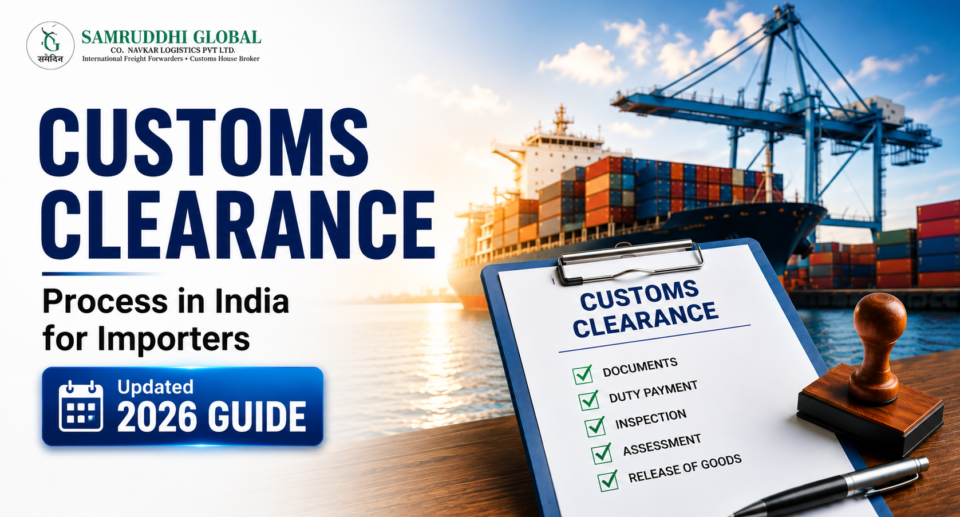
Importing goods into India is a structured legal process governed by Indian Customs regulations. Every shipment entering the country must go through customs clearance before it can be released for domestic use.
Whether you are importing through JNPT (Nhava Sheva), Mumbai Air Cargo, Mundra Port, Chennai Port, or any ICD, understanding the customs clearance process in India is essential for avoiding delays, penalties, demurrage charges, and compliance issues.
In today’s global trade environment, even a small documentation error or incorrect HS code classification can lead to shipment hold, inspection delays, or financial losses.
This detailed 2026 guide explains the complete import customs clearance process, required documents, step-by-step procedure, timelines, costs, challenges, and the role of a licensed Customs House Agent (CHA).
What Is Customs Clearance?
Customs clearance is the official process through which imported goods are inspected, assessed, and approved by Indian Customs authorities before release.
It ensures:
- Legal entry of goods into India
- Correct duty and tax collection
- Compliance with import regulations
- Prevention of restricted or illegal imports
Without customs clearance, goods cannot be delivered from ports or airports.
Why Customs Clearance Is Important for Importers
Customs clearance is a fundamental part of cross-border commerce, ensuring that goods comply with regulatory requirements before entering or leaving a country. It has a significant impact on supply chain performance, operational costs, and overall business efficiency.
1. Legal Compliance
Every importer must comply with Customs Act, DGFT regulations, and other government policies.
2. Cost Efficiency
Proper clearance helps avoid penalties, demurrage, detention, and storage charges.
3. Supply Chain Continuity
Delayed clearance can stop production lines and affect delivery commitments.
4. Risk Reduction
Proper documentation reduces the risk of cargo seizure or rejection.
5. Business Reputation
Timely import delivery improves customer trust and business performance.
Key Documents Required for Import Customs Clearance
Customs clearance depends heavily on correct documents. If any document is missing or incorrect, it can lead to delays or inspection issues.
Commercial Invoice
Contains product details, quantity, unit price, and total value of goods.
Packing List
Describes how goods are packed, including weight, dimensions, and packaging type.
Bill of Lading / Airway Bill
Transport document issued by shipping line or airline as proof of shipment.
Import Export Code (IEC)
Mandatory code issued by DGFT for all importers in India.
Insurance Certificate
Covers risk during transportation of goods.
Certificate of Origin
Indicates the country where goods are manufactured.
Product-Specific Licenses
Depending on goods type:
- FSSAI (Food products)
- BIS (Quality certification)
- CDSCO (Pharmaceuticals)
- Plant & Animal Quarantine approvals
Even a minor mismatch between invoice and packing list can delay customs clearance.
Step-by-Step Customs Clearance Process in India
Understanding the step-by-step process helps importers plan better and avoid delays.
1. Arrival of Goods and Import General Manifest (IGM)
When cargo reaches Indian ports like JNPT or Mumbai Air Cargo, the shipping line files the Import General Manifest (IGM) with customs authorities.
IGM contains:
- Vessel or flight details
- List of cargo onboard
- Consignee information
Without IGM filing, customs clearance cannot begin.
2. Filing of Bill of Entry
The Bill of Entry is the most important document in import clearance.
It is filed electronically through ICEGATE by the importer or a licensed CHA.
It includes:
- HS code classification
- Product description
- Customs value
- Duty estimation
- Importer details
Accuracy in this step is critical because it determines duty calculation and inspection probability.
3. Customs Assessment
After filing, customs authorities assess the declaration.
They verify:
- HS code classification
- Declared value of goods
- Import compliance
- Applicable restrictions
- Supporting documents
If discrepancies are found, customs may raise queries or request additional documents.
4. Calculation and Payment of Customs Duty
Once assessment is complete, applicable duties are calculated.
Common duties include:
- Basic Customs Duty (BCD)
- Integrated GST (IGST)
- Social Welfare Surcharge
- Anti-dumping duty (if applicable)
- Safeguard duty (if applicable)
Payment is made electronically via ICEGATE system.
Duty calculation depends heavily on HS code accuracy.
5. Customs Examination of Goods
Customs may select shipments for inspection based on risk profiling.
Clearance Channels:
Green Channel
- No physical inspection
- Direct release
Yellow Channel
- Document verification
Red Channel
- Physical examination of goods
Most delays occur in the red channel due to inspection or document mismatch.
6. Out of Charge (OOC) Order
Once customs is satisfied with documents, assessment, and inspection, they issue an Out of Charge (OOC).
This is the final clearance stage confirming goods are released.
After OOC, importers can take delivery of cargo from port or warehouse.
Customs Clearance Timelines in India (2026)
| Port / Airport | Average Clearance Time |
| JNPT (Nhava Sheva) | 2–4 Days |
| Mundra Port | 2–4 Days |
| Chennai Port | 3–5 Days |
| Mumbai Air Cargo | 1–2 Days |
| Kolkata Port | 3–5 Days |
Air cargo is faster but more expensive, while sea freight is cost-effective for bulk imports.
Common Reasons for Customs Clearance Delays
Even experienced importers face delays due to:
1. Incorrect HS Code Classification
Leads to duty mismatch and reassessment.
2. Missing or Incomplete Documents
Even one missing document can hold shipment.
3. Incorrect Valuation
Undervaluation or overvaluation triggers customs scrutiny.
4. Regulatory Approval Issues
Products like food, electronics, and pharma require special approvals.
5. Late Duty Payment
Delays final clearance and increases storage cost.
Hidden Costs in Import Customs Clearance
Importers often calculate only customs duty but ignore additional costs:
- Demurrage charges (container storage at port)
- Detention charges (container usage fees)
- Port handling charges
- CHA service charges
- Transportation delays
- Warehouse storage charges
- Documentation correction costs
In many cases, these hidden charges exceed actual customs duty.
How to Avoid Customs Clearance Delays
To ensure smooth import operations:
- Verify documents before shipment departure
- Use correct HS code classification
- Obtain regulatory approvals in advance
- File Bill of Entry early
- Ensure timely duty payment
- Work with experienced CHA professionals
- Maintain complete import records
Prevention is always cheaper than delay cost.
Role of a Licensed Customs House Agent (CHA)
A CHA plays a key role in simplifying import operations.
CHA Responsibilities:
- Filing Bill of Entry on ICEGATE
- Coordinating with customs officers
- Handling documentation accuracy
- Duty calculation and compliance
- Managing inspection process
- Ensuring smooth cargo release
A professional CHA reduces clearance time and avoids costly mistakes.
Customs Clearance at Major Indian Ports
India has multiple import gateways:
- JNPT (Nhava Sheva)
- Mundra Port
- Chennai Port
- Mumbai Air Cargo
- Kolkata Port
Among these, JNPT handles the highest container volume in India, making it the most important port for importers.
Freight Forwarding and Customs Clearance Connection
Customs clearance is closely linked with freight forwarding services.
A complete logistics chain includes:
- International shipping
- Cargo booking and consolidation
- Documentation handling
- Customs clearance
- Final delivery
Integrated logistics reduces delays and improves efficiency.
Future of Customs Clearance in India
India is moving toward fully digital customs systems:
- Faceless assessment
- AI-based risk analysis
- ICEGATE modernization
- Paperless documentation
- Faster clearance approvals
These improvements aim to make the import process faster and more transparent.
Conclusion
The customs clearance process in India is structured but requires precision, documentation accuracy, and timely execution. Every step — from IGM filing to OOC — plays a critical role in successful import operations.
Importers who plan properly and work with experienced CHA professionals can reduce delays, avoid unnecessary costs, and improve supply chain efficiency.
Whether importing through JNPT, Mundra, or Mumbai Air Cargo, smooth customs clearance is essential for business success in international trade.