How to Calculate Landed Cost for Imported Goods in India (2026): Complete Guide

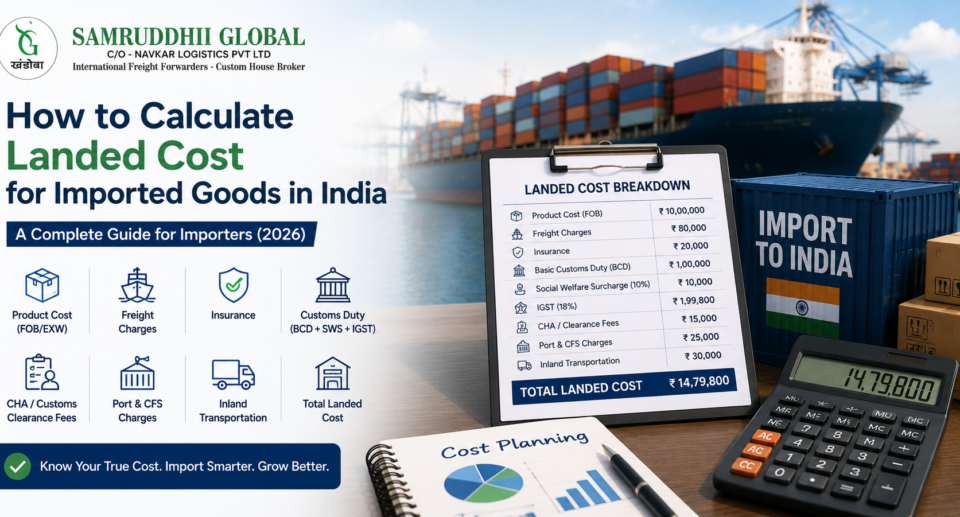
Every importer eventually asks the same question, usually while staring at a supplier quote or a Bill of Entry: how does the final cost end up so much higher than the product price? The answer is that the landed cost is not one number — it’s a stack of charges, each calculated on top of the one before it. Once you understand this stack, you can estimate your true cost before placing an order, instead of discovering it after your cargo has already sailed.
This guide walks through exactly how landed cost is calculated in India, with a full worked example, and covers the details that catch first-time importers off guard.
What Is a Landed Cost?
The landed cost is the total cost of getting a product from your supplier’s factory to your warehouse door — fully cleared, duty-paid, and ready for sale or use. It goes well beyond the invoice value of the goods. A complete landed cost calculation includes:
- Product cost (FOB or EXW value from your supplier)
- Freight charges (sea or air)
- Insurance
- Customs duty (BCD + Social Welfare Surcharge + IGST + any applicable cess)
- CHA/customs clearance fees
- Port handling and CFS (Container Freight Station) charges
- Inland transportation from port to warehouse
Businesses that only calculate product and freight cost — and underestimate duty and clearance charges — routinely find their actual profit margin comes in lower than expected. Understanding the full stack upfront prevents this.
Why Landed Cost Matters for Importers
Many importers focus only on the supplier’s quoted price when planning a shipment. However, the actual profitability of an import transaction depends on the total landed cost rather than the purchase price alone. Even a small miscalculation in customs duty, freight charges, or port handling fees can significantly reduce profit margins.
Understanding landed cost helps businesses:
- Set accurate selling prices.
- Prepare realistic import budgets.
- Compare suppliers effectively.
- Avoid unexpected customs expenses.
- Improve cash flow planning.
- Make informed sourcing decisions.
Whether you import machinery, electronics, chemicals, textiles, or consumer goods, calculating landed cost before placing an order helps you avoid costly surprises after your shipment arrives in India.
Step 1: Determine the Assessable Value (AV)
Before any duty is calculated, customs determine the Assessable Value of your shipment. For most imports, this is the CIF value — Cost of goods, plus Insurance, plus Freight, converted to Indian Rupees.
A key detail many importers miss: if your supplier quoted you on CIF terms, your invoice value is already close to the assessable value. But if you bought on FOB or EXW terms, freight and insurance must be added before duty is calculated — this is one of the quiet ways your choice of Incoterm affects your final landed cost.
The value is converted to rupees using the exchange rate notified by CBIC (not the market or bank rate on the day you pay), based on the rate in force on the date of filing the Bill of Entry. Customs can also question a declared value that looks unusually low compared to similar imports, so accurate invoicing matters.
Step 2: Calculate Basic Customs Duty (BCD)
Basic Customs Duty is the primary tariff on imported goods, levied under the Customs Tariff Act, 1975. The rate depends entirely on your product’s HS code (Harmonized System code) — and rates vary hugely, from 0% on essential raw materials to over 100% on certain protected categories like some agricultural or luxury goods.
Formula: BCD = BCD rate × Assessable Value
Example: if your Assessable Value is ₹10,00,000 and the applicable BCD rate is 10%, your BCD works out to ₹1,00,000.
Step 3: Calculate Social Welfare Surcharge (SWS)
SWS was introduced in 2018 to fund government social schemes, replacing the earlier education cess. It’s calculated as a flat 10% of your BCD amount — not on the product value directly.
Formula: SWS = 10% × BCD
Continuing the example above: 10% of ₹1,00,000 BCD gives you an SWS of ₹10,000.
Step 4: Calculate IGST
This is the step where the cascading effect really shows up, and it’s what surprises most first-time importers. IGST is charged at the same rate the product would attract under domestic GST — typically 5%, 12%, 18%, or 28% depending on the category. But crucially, it’s not calculated on your invoice value alone. It’s calculated on the Assessable Value plus BCD plus SWS.
Formula: IGST = (Assessable Value + BCD + SWS) × IGST rate
Continuing our example with an 18% IGST rate: IGST = (₹10,00,000 + ₹1,00,000 + ₹10,000) × 18% = ₹1,99,800
Step 5: Add It All Up
Total duty = BCD + SWS + IGST
For our example: ₹1,00,000 + ₹10,000 + ₹1,99,800 = ₹3,09,800
Notice something important here: even though the “duty rate” most people quote is just the 10% BCD, the total duty outgo comes to just under 31% of the cargo value. The IGST component alone accounts for nearly two-thirds of the total amount paid at customs.
The Detail That Changes Your Real Cost: Input Tax Credit
Here’s where many importers miscalculate their actual cost impact. If you’re a GST-registered business importing for business use, the IGST you pay at customs is available as Input Tax Credit (ITC) — exactly like GST paid on a domestic purchase. It affects your cash flow at the moment of clearance, but it is not a permanent cost; you recover it later through your GST returns.
BCD and SWS, however, are not creditable. They go straight into your landed cost per unit, permanently.
So in our worked example, for a GST-registered importer:
- Real permanent duty cost: ₹1,10,000 (BCD + SWS)
- Temporarily blocked cash (recoverable via ITC): ₹1,99,800
This distinction matters enormously if you’re comparing supplier quotes or setting your product’s selling price — treating the full ₹3,09,800 as a permanent cost would make your pricing overly conservative, while ignoring the cash-flow impact of the IGST could leave you short on working capital around clearance time.
Don’t Forget These Additional Landed Cost Components
Beyond BCD, SWS, and IGST, your complete landed cost calculation should also include:
- Compensation Cess — applicable only on specific goods like tobacco, aerated beverages, and luxury cars
- Anti-Dumping Duty — applies to specific product categories (certain steel, chemicals, and machinery components) where goods are found to be sold below fair market value; this is charged on top of standard duty and can significantly increase your landed cost
- CHA and customs clearance fees — your customs broker’s professional charges for filing, coordination, and compliance
- Port handling and CFS charges — terminal and container freight station fees
- Demurrage and detention — daily charges if your cargo sits at port beyond the free period, usually because of documentation delays or pending regulatory approvals
- Inland transportation — moving cleared cargo from the port/CFS to your warehouse
A Full Worked Example
Let’s put the entire stack together for a shipment of machinery components:
| Component | Amount |
| CIF Value (Assessable Value) | ₹10,00,000 |
| BCD @ 10% | ₹1,00,000 |
| SWS @ 10% of BCD | ₹10,000 |
| IGST @ 18% on (AV+BCD+SWS) | ₹1,99,800 |
| Total Customs Duty | ₹3,09,800 |
| CHA/clearance fees (approx.) | ₹15,000 |
| Port handling & CFS charges (approx.) | ₹20,000 |
| Inland transport to warehouse (approx.) | ₹25,000 |
| Estimated Total Landed Cost | ~₹13,69,800 |
(Figures are illustrative — actual clearance, handling, and transport charges vary by shipment size, port, and route.)
Reducing Your Landed Cost: What’s Actually Possible
- Check FTA/preferential tariff eligibility. Agreements like India-ASEAN, India-UAE CEPA, India-Australia ECTA, and the newly rolling out India-UK CETA offer reduced or nil BCD on covered products — provided you have a valid Certificate of Origin and meet the rules of origin requirements.
- Get your HS code classification right the first time. Different HS codes carry vastly different BCD rates; a misclassification can cost you lakhs, either through overpayment or through penalties if under-classified.
- Use Advance Authorization or EPCG schemes if you export too. These allow duty-free import of inputs or capital goods against an export obligation, which can substantially reduce your BCD burden if your business model fits.
- Avoid demurrage through documentation readiness. Since demurrage and detention are entirely avoidable costs driven by delays, having your paperwork complete before the shipment arrives keeps your landed cost closer to your original estimate.
Manual Calculation vs Professional Customs Assistance
| Manual Calculation | Professional CHA Support |
| Time-consuming | Faster calculations |
| Risk of incorrect HS Code | Correct product classification |
| Possible duty calculation errors | Accurate customs assessment |
| Limited knowledge of exemptions | Better utilization of applicable benefits |
| Higher compliance risk | Improved regulatory compliance |
Working with an experienced Customs House Agent helps businesses estimate landed costs more accurately while reducing the risk of customs delays and additional charges.
Common Mistakes That Distort Landed Cost Estimates
- Using FOB value instead of CIF for duty calculation — customs assessable value is always based on CIF, so skipping freight and insurance in your estimate understates your duty
- Applying the wrong exchange rate — CBIC’s notified rate applies, not your bank’s daily rate
- Ignoring SWS — a small percentage that’s easy to forget but still adds to your cost
- Treating IGST as a permanent cost when you’re GST-registered — this overstates your real cost and can distort your pricing decisions
- Forgetting anti-dumping duty checks — for applicable categories, this can silently double your expected duty outgo
Why Working With an Experienced CHA Matters Here
Landed cost calculation looks straightforward on paper, but in practice it depends on accurate HS code classification, correct assessable value determination, and awareness of category-specific duties like anti-dumping or compensation cess — details that change by product and are easy to get wrong without hands-on experience. A licensed Customs House Agent verifies these calculations before your shipment moves, so your budgeted landed cost matches your actual cost, with no surprises at clearance.
Conclusion
The landed cost is never just your invoice value plus a flat “duty rate.” It’s a cascading stack — Assessable Value, BCD, SWS, and IGST, calculated in sequence, plus clearance and logistics charges on top. Understanding each layer, and knowing which components are recoverable versus permanent, is what separates accurate cost planning from guesswork.
Samruddhii Global, a licensed Customs House Agent operating at Nhava Sheva (JNPT) and Mumbai Air Cargo Complex, helps importers calculate accurate landed costs, classify goods correctly, and identify duty-saving opportunities before their shipment ever leaves the origin port.